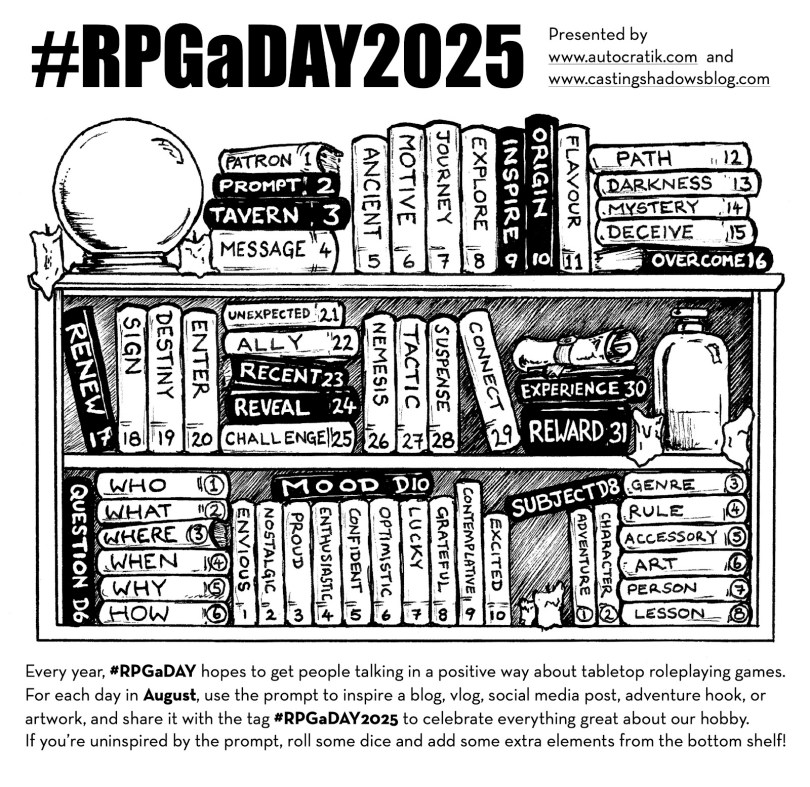
I’ve been posting about RPGaDay most of the month now. Missed the first few days, but it’s been steady ever since. Lots of thoughts and ideas on running games, on game design, rules, concepts, as they relate to the daily prompts.
Truth be told, though, I don’t have a plan here. Every day brings a new prompt, and every day, I just sit down and write something that comes to mind. Often, I don’t even know what to write about until after it’s done. No plan, no tactic to the challenge. Just winging it.
That’s how I run my games, too. One session at a time. See what happens. Let the players lead me along with their ideas, react by solving their solutions to whatever problem is in front of them, then let their reactions inform my next step.
Now. That’s not to say I don’t have a vision. An ideal ending, a final destination. A goal to reach. I think that’s a writer thing? The planners and the pantsers–one plots the the whole thing they want to write, the other finds out as they go. Flies by the seat of their pants. That’s so totally me, for sure. I have some ideas of what should be coming up, which story beats I think are neat. Character reveals, twists, betrayals, all that. But I never really know when, where, how, why, what.
Running tactical games is a little different, of course. For that, I will seek out maps, plan encounters, balance and set up fights. In fact, it’s the most time I spend on planning my current games of Draw Steel. Because, I think, it’s important to have these things sorted out. Combats are complex, they take time, and there’s lots going on, so I make sure they’re designed well enough to keep it fun and interesting.
Story, though, it’s a lot more loose. To me, there are no facts until it’s said out loud in game. Maybe I had an idea for an NPC’s motivation toward the party. But if I have a better idea later on, based on more ideas and events, I will just change it. Most often, the players won’t know the difference, as they don’t see any notes I might have. I adjust narrative facts as I see fit, while respecting what’s established. Even if things have been established, things can be changed later within the context of the goings-on.
I have this tendency to throw in story beats, twists, reveals, which I never thought of before in the heat of the moment. Just a cool line of an NPC that doesn’t fit any of the things I jotted down up to this point. And then I will spend a week trying to square that circle, often pacing back and forth, or spending another sleepless night dreading about it. About why the fuck would I have done that in the last game?! And, pretty much all the time, I have these breakthrough moments. These ideas that just make it make sense. Using random prompts can help me get there, too. And if everything goes well, I can introduce these new ideas the next time–hopefully before I add something else unexpected I must deal with later. Ha.
The reason I’m telling you all of this is because I want to reassure everyone that it’s fine to just make shit up as you go. Here’s the secret: know your goals. Have a vision. Have an idea of where you want to land, without thinking about how you’ll get there. The game is the journey, after all. Players will pull and push your plans in every possible direction. No plans can withstand the, erm, creativity of player imagination.
Sly Flourish has a lot of good insights into running games in his Lazy DM series. Probably the best advice is to have a list of possible secrets the players could learn during the course of a sessions. And secrets could be all sorts of plot-related information. Just have that list of things you want them to learn, and insert them whenever it would makes sense. Whenever it feels right.
If there’s any tactic to running games, let it be this: Let it go. Know where you want to end up, and enjoy the ride there.
Discover more from Behind The Wall
Subscribe to get the latest posts sent to your email.
 Behind The Wall