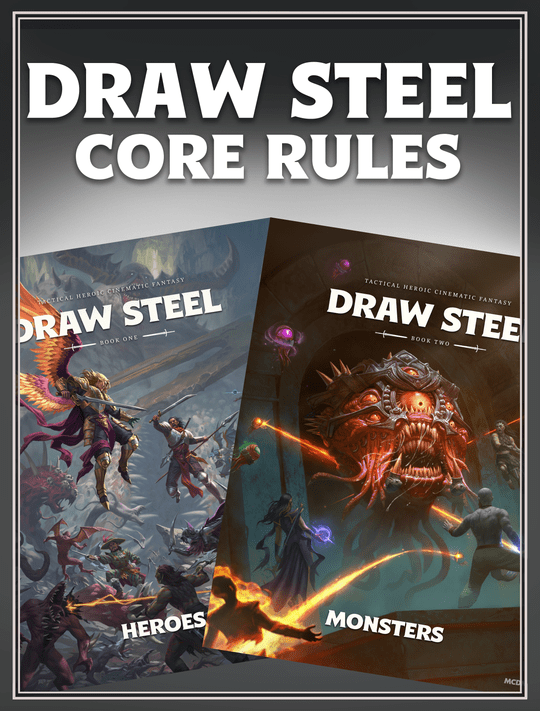
After a very successful Backerkit campaign back in January 2024, today, July 31st 2025, Draw Steel by MCDM released into version 1 as PDF.
In short, Draw Steel is a Heroic Fantasy Roleplaying Game. It sits alongside Dungeons & Dragons, Pathfinder, and many other such games. Characters have levels, classes, ancestries, which all give them statistics and abilities to mostly fight monsters in a fantasy setting using grid-based combat.
However, there a bunch of key differences or fresh takes on these ideas, which make Draw Steel stand out.
Less Attrition, More Momentum
In Draw Steel, heroes become more powerful the longer they go without resting. The same is true for each individual fight they might get into to. Heroes build up their power every round, as well as one challenging situation after another.
Heroic Resource
During a fight, each hero gains points of their specific heroic resource (Insight for Shadow, Ferocity for the Fury, Clarity for Talent). They all get some points at the start of their turn, and each class has some other means to get more points when certain things happen during combat. The Fury gains points when they take damage, the Elementalist when someone takes damage that isn’t untyped (i.e. Fire), or the Troubadour whenever a hero dies.
Once you have enough points, you can spend them on powerful abilities. A level 1 character has a 3-cost and a 5-cost ability to start, and as they reach higher levels, more costly abilities become available. Everyone also gains some minor perks or boosts on which they can spend 1 or more of their resource as the fight goes on. The Tactician, for example, can spend a point of Focus to enhance an ally’s strike a monster they have marked.
Victories
After winning a fight, or when succeeding at other challenges such as puzzles or negotiations, characters gain 1 or more victories. Victories grand the heroes an equal amount of their heroic resource at the start of a new combat encounter. That means that they can unleash their most powerful abilities early in a fight, maybe even in round 1.
Stamina & Recoveries
Heroes have Stamina–the total amount of damage they can take before are defeated. When they fall below half their total stamina, they become winded. Some effects trigger of that status. At 0 stamina, the hero becomes dying. While dying, they can still act, but are also considered bleeding, meaning they take damage whenever they take an action of any kind. If they go below 0 stamina and reach their negative winded value (or half their max stamina), they die.
Heroes also have a limited amount of Recoveries. Most healing in the game is based on recoveries, allowing the hero to regain stamina equal to a third of their maximum stamina (Stamina increases in the game are math’d to be easily divided by 3). When someone or something allows you to heal (such as you taking the Catch Breath maneuver), you spend a recovery and get its value in stamina. There are other ways the game might interact with this. The Censor class, for example, lets the Censor spend one of their recoveries to heal an ally by an amount equal to the Censor’s recovery value. Sometimes a hero might get a free recovery, like when they drink a healing potion. Free recoveries heal them by an amount equal to their recovery value, without using up one of their recoveries.
Recoveries only return when the hero rests.
Respites
Eventually, the heroes must rest as they run out of recoveries. This phase of the adventure is called Respite and takes at least 24 hours in a safe place. Normal sleeping and taking a break don’t qualify as a respite, so the game isn’t really split into “adventuring days.” The time between respites could be a day, but it could also cover a week or a month, depending on the pace of the narrative.
During a respite, characters can take on downtime projects (crafting, socializing, etc), regain all of their recoveries, and convert all of their victories into experience.
Heroic Resource, Victories, and Recoveries create this great dynamic of becoming more powerful as they adventure continues, while also causing the heroes to become more exhausted and battered. Eventually, they might have to make a choice:
- Do we push on and leverage our momentum in the next fight, potentially ending a fight after just a round or two with our most powerful abilities?
- Or do we stop and rest, regaining recoveries and converting victories to experience, which could lead to us leveling up?
Engagement
Draw Steel uses 2d10 plus modifiers to resolve actions, instead of just a single die, like, let’s say, a d20. When you roll a single die, you have an equal chance to get any one result–for a d20, the chance is 1 in 20, or 5%, to roll a 20, to roll a 1, or to roll any of the other 18 numbers in between. It’s swingy, which is fine for some type of games.
Rolling two dice gives you this nice and smooth probability curve. The most common result on rolling 2d10 is 11. The least likely results are 2 and 20. So, players (and designers) have some sort of idea of how they will do when they roll and a better sense of how their modifiers might impact the results.
Adding to that is Draw Steels approach to tiered results. Inspired by games like those powered by the Apocalypse, each 2d10 roll in Draw Steel has three potential outcomes:
- 11 or less: Tier 1
- 12-16: Tier 2
- 17+: Tier 3
Out of combat, each tier could mean various outcomes based on the difficult of the test, from Failure with Consequences to Success with Reward.
In combat, however, each result does something. Even a Tier 1 result on an attack does some damage, or has some minor effect. In other words, heroes–and monsters–never miss in Draw Steel. Each turn, something happens that brings the fight closer to an end, one way or another.
On top of that, each hero has at least some ways to act outside of their own turns using triggered actions and free triggered actions.
Knowing that they’ll be able to do something on your turn, instead of wasting it with a bad die roll, and being able to affect the fight outside of their turn, helps in keeping players engaged during combat. Just paying attention to when you would gain extra heroic resources because of what’s happening in a fight could keep you excited, as it might allow you to do even cooler stuff in your next turn.
Fully Realized Heroes
Draw Steel is a game about fighting monsters. To that end, its character creation tools help you create a fully realized monster-fighting hero.
You choose an Ancestry (Game director and lead writer Matt Colville‘s personal take on a lot of the classics, plus some that are more original), and then you create a background. For that, you pick an Environment (where did you come from), an Upbringing (how did you grow up there), and a Career (what did you do before becoming a hero). All of these options offer choices for skills, languages, and the usual fantasy game selections.
The Career also offers a 1d6 random table to create an inciting incident–the thing that made you become a hero, leaving your old life behind. You can roll, you can choose, you can come up with your own, but one way or another, something happened, something was taken from you, and now you’re out there trying to make a difference. Whether your reasons are fame and fortune, vengeance, or guilt, you are a hero now. That is the buy-in for the game. Being a hero is not optional in the core assumptions of the game, adventures, and overall fantasy.
Classes, too, start you off with a lot of choices. When you start a game of Draw Steel with a fresh character, they already are a hero. They already have powerful abilities and probably a few heroic deeds behind them. Gone are the days of a farmer taking up a rusty sword to start their journey as a level 1 Fighter, who can swing their weapon once a turn with a chance to miss and do nothing until it’s their turn again. Level 1 heroes in Draw Steel have many options right from the start, build momentum as they go, and are already good at what they do.
Building characters with strong identities isn’t unique to Draw Steel, of course. But it’s worth mentioning that the systems in place for character creation strongly reinforce the themes and fantasies of what Draw Steel is about. The team worked hard on getting this right, and I feel they succeed.
Not Just Combat
Draw Steel makes no secret about the fact that fighting monsters is its primary focus. And the design does its best to keep fights engaging, tactical, and impressive.
But the game also offers a robust skill system, multiple degrees of success on a roll (instead of just a binary success/failure), and many flavorful abilities and perks to enhance the fantasy of being this ancestry and that class in the world.
Montage Tests
The game also offers rules for Montage Tests, which are, as the name suggests, a collection of scenes and situations for the the players to engage with to reach a certain goal.
Cross a dangerous forest during a rain storm; Escort a merchant caravan safely across a rocky desert; Prepare a town for an incoming invasion of War Dogs.
Players usually two rounds to each create a scenes to deal with a challenge. The Director can lay out a handful of challenges for the players to overcome, but they’re usually free to also create their own scenes and challenges they think might fit the montage. What they do and how they do it is always a conversation between players and Director.
If they succeed a number of times before failing a number of times or the two rounds are up, based on the difficulty of the montage, they succeed. There’s a gradient here, as well: Complete Success, Partial Success, Failure.
It’s a classic skill challenge, and the rules for it are simple and effective.
Negotiations
Draw Steel also comes with a set of systems to handle important negotiations with likewise important NPC.
These NPC have several motivations and pitfalls, as well as interest and patience scores. Motivations and pitfalls are based on 12 basic types (Peace, Greed, Power, etc), but then tailored to fit the personality and goal of the NPC.
The party will try to uncover and appeal to motivations while avoiding pitfalls to increase interests before patience runs out. It gamifies roleplay in an interesting way, and once you get used to it, I believe it adds tension and enhances important negotiations that can change the face of the adventure.
Negotiations are always initiated by the players and, while the NPC still has patience, they decide when they want to end it. If, for example, they reached an interest of 3, the NPC will give them what they want, but will ask something in return. A Yes, But, so to speak. Now the players must decided whether they take it, or if they push their luck and try to make better arguments to increase that interest to 4, gaining a strong Yes without conditions.
It’s up to the Director to tell the party the interest and patience scores. I prefer being transparent about these, letting the players make informed decisions and get a sense of the tensions and stakes rising as they make their arguments. Otherwise, the Director can make strong suggestions to signal the NPC standings, such as warning the heroes to watch their tone when their patience decreases, or giving a nod of approval and a welcoming gesture when the interests goes up.
Motivations and pitfalls are unknown, however, unless they make efforts to uncover them before or during the negotiation (or if it would make sense in the fiction that they would know about some of them).
It’s important to note that negotiations are reserved for important NPC and situations. Convincing a guard to let you into the noble’s estate would not be a negotiation and require, at most, a test to get by them. Talking to the noble, however, trying to get them to do what they heroes need them to do, would be a negotiation.
It’s a cool system and we have used it to great effect already.
But Also A Lot Of Combat
Combat in Draw Steel is always tense, even as enemy forces diminish.
Directors get a resource called Malice to boost their monsters. Better yet, the more victories the heroes have a the start of a fight, the more malice the Director starts with. And with each round, they gain even more malice than the round before.
Malice is spent on activating or enhancing monster abilities as detailed in their statblocks, as well as on generic malice abilities based on monster type, each enemy of that type can use (i.e. Goblin Malice, which every Goblin has access to).
The book is making it clear that combat encounters should serve the narrative. No random encounters or fights just to use up the party’s resources. It also makes a point of clarifying that not all creatures you find are inherently evil. Most goblins just want to live their lives, and it’s just this group at this moment that acts in a manner that causes harm to others for their own selfish interests.
Running monsters in general works well for me. Monsters have the same action economy as heroes (Move Action, Maneuver, Main Action), but their choices are much more limited for each. Monsters always have a signature action, and then maybe a maneuver option, another action, or malice-based actions. Sometimes, they also have triggered actions.
Leader and Solo type monsters are more complex, and they also gain Villain actions which are out-of-turn abilities that are often extremely powerful, but can only be used once each. These actions help Leaders, and especially Solo monsters, to keep the pressure on the heroes. The third and final Villain action is often super powerful and can turn the tides of battle in an instant.
Minions are another great design by MCDM. They can’t do much, but they come in squads of 4-8 and share Stamina between them as one single pool per squad. Even if a hero only attacks a single minions, dealing enough damage might allow them to defeat additional minions, and they get to describe how their attack takes out that other minion regardless of distance of cover or whatever. It’s fast and efficient, let’s the Director clutter the board with lots of bad guys, without becoming overwhelming to run or fight. And taking out multiple minions across the map with a single strike feels epic and cool.
Conclusion
It’s a great game.
There’s much more to discover in the book, like how heroes recruit retainers as they gain renown, or how gear kits are a great innovation to replace tracking equipment, or how crafting your own treasures is part of the core design.
Draw Steel is a heroic fantasy game made from the ground up. It’s not a clone or fork or adaptation of previous games in the genre, but it does have strong influences from many games that came before. The design team tore apart all the things they loved and hated about the games they played for many, many years, worked out how these things tick and why they are even a thing, and put it all back together from first principles to create Draw Steel.
My group and I have been playing it since the latest playtest package, which came out late 2024. It has become our weekly game pretty much from the start. We previously played D&D 5e game, Lancer, and Pathfinder 2e, and Draw Steel stands as great successor to those games for us.
MCDM has their own Patreon, where supporters get exclusive behind the scenes look at how their games are made, access to playtest material, and even access to published content if they’re subscribed long enough to cover the cost.
Both Matt Colville (game director) and James Introcaso (lead designer) regularly go live on Twitch to talk about Draw Steel and other things. Matt likes to just hangout on stream, while James has regular Q&A streams about the game. MCDM also has a Youtube channel which features a lot of the Patreon content in more digestible format, including official Q&As about Draw Steel hosted by Dael Kingsmill.
Discover more from Behind The Wall
Subscribe to get the latest posts sent to your email.
 Behind The Wall