Whenever I think about game design, I often end up thinking about my favorite video games and how to capture those mechanics in some interesting way. Not to copy them, but to emulate them. Be inspired by them.
One of my all-time favorite video games is Jagged Alliance 2. You play as commander of a small band of mercenaries, which you hire and manage from a fake computer interface. Each of them has a personality, likes and dislikes, and even relationships with other mercs. You’re on a mission to liberate a country oppressed by a tyrannical leader, working together with the local resistance group, and exploring said country through a square grid map with all sorts of interesting things scattered around.
When it cuts to the action, you zoom into the current grid your group occupies, where the gameplay turns from faux-OS to an isometric view of the location–a town, a rough terrain, a military compound–and you get to move your people around, explore the location, talk to locals, kick in doors, and try to eliminate the enemy soldiers before they eliminate you. Everything but that last part is played out in real-time. But the moment you spot an enemy (or they spot you), the game goes into turn-based combat mode.
Turns are played out one side at a time. When it’s your time, you get to act with all of your mercs at once, resolving their actions in any order you like. The enemies do the same, and then all neutrals get to act (run around and hide, riveting stuff to watch play out)
During you your turn, each of you characters has Action Points you can spend to do stuff. Shooting costs some points. Walking costs, but running is cheaper and louder. Crouching costs more. Opening a door costs some points. Aiming to get a better shot adds to the cost of shooting. Everything you want to do costs some precious points. Any leftover is carried to the next round, where each merc gets more points based on some math regarding attributes and wounds.
It’s not revolutionary game design. Many games have done this before and since, but JA2 is the one I love to death.
Action Points
“Action Points” is something I always wanted to make work.
Here’s the thing though: Bookkeeping sucks. Maybe if you’re into super crunchy simulationist type games, you’d disagree with me, but in my general experience with modern games, players, and sensibilities, most people don’t want to track so much stuff anymore. To each their own, and all that.
But I want Action Points to work. I have wanted to make that work for many, many years. Problem is, you’d have to count what you use up for each action, count how much you get back each turn, count how much you aren’t getting back for reasons, and keep all those numbers straight besides all the mechanics and numbers a TTRPG of a not rules-lite persuasion requires. Let alone all the other tactical stuff like positioning, effects, line of sight, and and and.
Pathfinder 2 sort of has action points? Everyone gets 3 of them. An action, any action, costs 1 or more of these points. That does seem like a streamlined version of what I’m talking about, and I think it works well from the few times I’ve played it.
But I want something a bit more dynamic. Something that feels a bit more like spending a resource or currency to act and react during a fight.
So. How do we track these points without burning through our character sheet by constantly marking and erasing our current pool of action points? Well, easy: Tokens. You have some sort of physical representation of the your points collected as a pool in front of you. You want to do something, take as many tokens as it requires and remove them from you pool. You earn points, add tokens. Surely, that has been done before.
It’s not enough, though. Counting literally beans is better than marking and erasing, but it still feels a little shallow. Just a transaction made. The points/tokens/legumes are just a currency and nothing more.
Okay, but what if we give the tokens more design weight? What if action points don’t just gate the actions, but are the action?
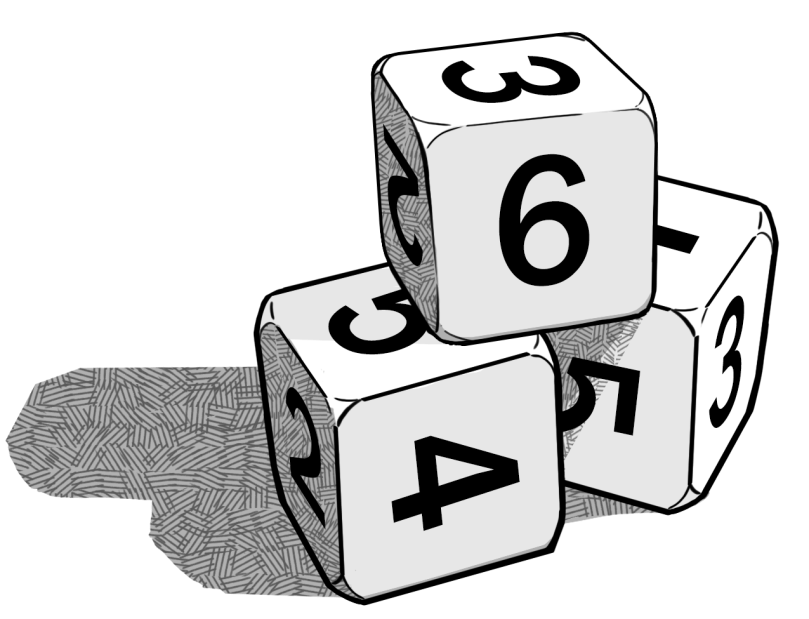
What if we make them dice?
Dice Pools
Many games use dice pools (I grew up on Shadowrun and Vampire, which use d6 and d10 dice pools respectively). Dice pools are as old as games that use dice. And they all work differently—sometimes slightly, sometimes drastically. Sometimes you roll them all and look for any result of 5 or 6. Other games just want you to keep the highest result. Or they explode, letting you reroll any dice that land on the highest value.
Here’s what I’m thinking.
Picture this. It’s your turn to act in a fight while playing generic TTRPG title. Before you are a bunch of six-sided dice, and the start of your turn, you add a bunch more. And with them, you can do some minor things like moving around or interacting with the environment. Simply remove however many points it costs to do these things from the pool. Easy.
But when you do something cool, like attacking an enemy or casting a spell or operating a murder drone hovering far above the arena, you don’t just remove the dice from the pool. Instead, you pick them up and roll them. Better yet: you can add more dice from that pool to power up the action. You aim your shot, you charge your spell, you put the drone into overdrive.
Now the action points aren’t just tokens. They are the core dice mechanic of the game. They are easy to track, and getting a shit-ton of them feels great. Picking them up, adding a few more for good measure, and making the roll becomes how you track your points. Your actions. It’s tactile. It’s engaging. Dice pools are awesome.
Core Mechanic
Okay, you start your turn, you’ve got a dozen or so dice in front of you. You attack an enemy, which costs something like 4 dice, so you pick those up, ready to roll. Rolling more dice is better for your odds/damage/effect, you think, so you grab four more. Or even eight. Grab them all, right? The more the better, and you refill the pool next turn anyways.
That’s not very interesting. While something like it could be a valid thing to do in a fight, it’d be better if thinking about how and when to spend your points was core to the gameplay.
I mentioned smaller actions earlier. Actions that don’t require a roll but cost points nonetheless. Moving one or more spaces on a grid could cost points–one action point per grid. Using a consumable, like a healing potion or grenade, could cost some small number of points. Switching weapons, reloading, you get the idea.
Active defense could costs points. Spend action points to dodge attacks or block with your weapon. Maybe you roll dice here, though for the sake of speed of resolution, off-turn reactions like that could just be a cost you spend and it happens. If you get shot at for, let’s say 4 damage (whatever that means), spend up to 4 action points to reduce that damage by the same amount. Maybe get a free move if you reduce the damage to zero, dodge-rolling out of the way like it’s Dark Souls. Or spend the cost of your weapon to apply its Block Value against an incoming melee strike.
You could also make multiple attacks if have you lots of points to spend, targeting multiple enemies at once with a barrage of arrows or a whirlwind of daggers.
Once we realize that every action costs some sort of points, on and off turn, we would have to think twice before pouring all of our dice into a single attack. We wouldn’t want to be left stranded, unable to move or dodge or block.
So, what happens when you roll the dice you spend on your actions? I’m thinking you’re looking for each die to show a certain number or higher. 4+ for example. These are Hits, and the more of them you get, the better. Once again tempting you to pour more action points into your dice pool.
I think there are a lot interesting ways to use dice pools like this, and in the future I’ll go over my iterations and ideas.
Conclusion
Dice pools are awesome.
Action points make fights feel more dynamic–instead of just a getting a main and a minor action of some sort, the player gets to decide precisely how their turn plays out. It opens up the design space in interesting ways, allowing for a whole lot of abilities, perks, traits, upgrades to interact with the dice pool in many different aspects. Making defense part of the action points might help players staying engaged outside of their turn. Maybe there is room for some sort of interrupt actions players can use their points on to mess with enemies.
One big issues I see right out of the gate: do enemies/NPC also get action points and dice pools? Must the GM track those for all monsters, do they get a large pool to spend on all of them? Well, I have Thoughts on enemy design and the role of the GM in general, so that’s something we’ll dig into in the future as well.
Spoiler warning: I have iterated on these concepts quite a bit already, and my current WiP, Project Star Quest, uses these very ideas as its core system.
I will talk about the different iterations and ideas in future posts as I catch you up with what Project Star Quest is, where it’s at, and how we got there.
Until then,
Catchphrase; sign off.
More Project Star Quest
Design Challenge: Conditions & Risks
Conditions are a staple of any tactical TTRPG. I want to streamline them into something that fits my core dice mechanic by making them part of Risks.
Action Points IV: Combat Basics
Combat is essential for this type of game, so let’s look at some of the basics for my WiP. Mockup ability examples included.
Action Points III: Action Economy
Let’s take a closer look at the types of things you get to actually do when playing the game.
Action Points II: Core Dice Mechanic
A closer look on how Action Points can work as a core dice mechanic.
So, you want to make a game?
Overview of designing my own TTRPG, Project Star Quest, why I did it, and what it is.
Discover more from Behind The Wall
Subscribe to get the latest posts sent to your email.
 Behind The Wall