
A long time ago, in a different world, I committed to a writing exercise using two pivotal tools: Fiasco and the Writer Emergency Pack. A twelve-week journey that allowed me to play Fiasco solo and led to the creation of my novella, Honeymoon.
Let me talk about these two things real quick.
Fiasco
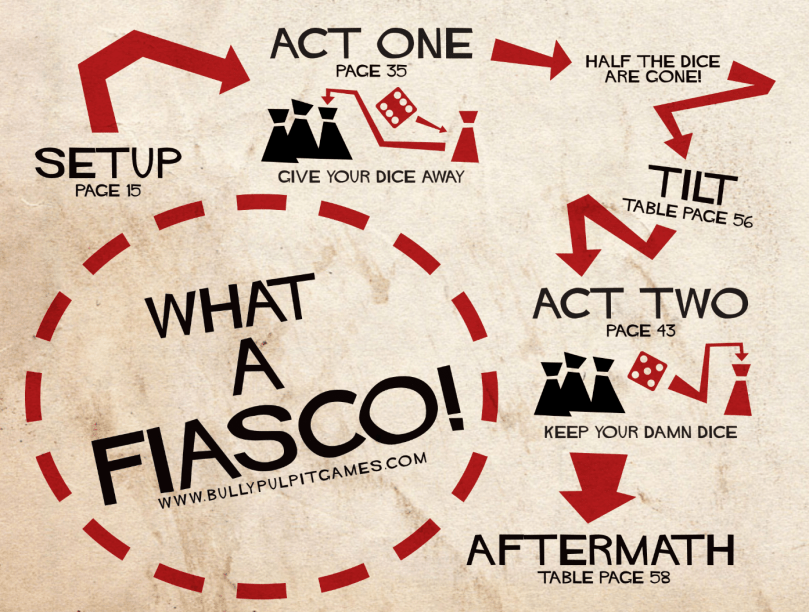
Fiasco is a role playing game designed by Bully Pulpit Games about people with high ambitions and poor impulse control. It’s as rules-light as a TTRPG can come, GM-less, and really more of an improv game, rather than a game about classes and powerful builds. In fact, you don’t even really build a character. Instead you determine the relationships between your characters, what is important to them, and create a story from there.
The goal of the game is to create an all-too-human story of flawed people trying to get ahead in life, pushing the envelope too much, too far, until it all descends into one hell of a–uh–fiasco. Think of caper movies, gangsters and mobsters, of people down on their luck and desperate. Coen Brothers movies, Breaking Bad, that kind of stuff.
Wil Wheaton and friends did an amazing playthrough of Fiasco on his old Geek & Sundry show, Tabletop. In fact, that episode is what made me aware of the game in the first place, and I did everything I could to get my hands on a copy of the book. I recommend watching the setup bonus episode, as well as the two parts of them actually playing the game. It’s a fun watch.
It’s the perfect game for writers and actors, but I have had fun playing with all sorts of people that like to play TTRPGs.
In Fiasco, you roll a handful of dice (four per player) and use the results to pick details from a list of relationships, needs, locations, and objects. These are provided by themed playsets that are meant to invoke a specific type of story.

Since it’s based on dice, the setup is somewhat random, so you never really know what you get when you sit down to play Fiasco. Each player gets to create or play out a scene on their turn to, hopefully, get their character ahead in the game. Each scene has a simple resolution mechanic: it’s either bad for them, or it’s good. When starting a new scene, the player can choose whether they get a good or bad outcome, but they are at the mercy of the other players, who get to establish the scene for them. Or they can choose to establish, maybe putting themselves in a good frame for the scene, but the others get to decide whether the scene resolves good or bad for them. During your scene, others play their characters or other NPC that might be part of it.
There are no systems or rules for the scenes themselves. It’s pure narrative exploration of characters and their goals and drives. The random elements determined at the start might play a role in a given scene, but it’s about as freeform as it can get.
The game has a few more rules past that, such as the Tilt Table that is rolled on halfway through the game, which introduces two really–really–bad twists for the characters. Also, at the end, there is a system for determining the Aftermath for all of your characters, which is based on the amount of good and bad scenes you had. These are represented by white and black dice–you get to roll all the ones you collected at the end. The more dice of a color you have, the better your chances for some decent outcome. But don’t count on that.
Writer Emergency Pack

The Writer Emergency Pack by John August of Quote Unquote Press is a deck of cards meant to help you get unstuck during your writing. Focus on your current scene, characters, or whatever else is going on, draw a card, and get inspired by it. Each card has two sides. The first has a title, art, and a quote to inspire you. The other has a few sentences explaining the idea behind that card, and a short list of exercises to help you think about your story or characters in different and new ways. They don’t tell what to do, they just get you thinking in new or interesting ways about what is you are already doing. Even if the card’s themes and exercise don’t fit your current situation at all, sometimes it can be helpful to just think through what-ifs to get the creativity flowing again.
It’s a great tool to have for any writer–random prompts and thought exercises are always a good way to break through the infamous writer’s block.
Writer Emergency Fiasco
So, how does all of this work together as a writing exercise?
First of, I use Fiasco to set up a situation. I pick a playset, roll some dice, and put together relationships and the details that are important to them. With all that in mind, I come up with characters and some backgrounds, as well as an initial situation. Given the nature of Fiasco, I don’t really need to plot out a lot of details ahead of time. All I need to know is who the characters are and in which order they get to act out their scenes. Usually, you simply go clockwise around the table. In this case, I’d determine it randomly or just decide.
From this point on, I essentially just “play” the game, establishing one scene at a time, writing a piece of short fiction for each. I decide randomly whether a given scene should resolve good or bad for the character, I will roll on the tilt table after everyone got their two scenes, and so on. Standard Fiasco stuff.
Here’s the twist, though: I will draw a card from the Writer Emergency Pack for every single scene. I will think about the card, get inspired, do the exercises on the back, and let the card be the prompt for the fiction. The thing with solo roleplaying is that it’s heavily reliant on prompts. Oracles, spark tables, random events–all tools to replace the GM and their guidance. In this case, the Pack will serve that function for each scene.
The cards aren’t law, though. Not so much a constraint as they are prompts to think about the scene in new and different ways. They are meant to spark ideas based on the art, the flavor texts, or the exercises on the back. Sometimes that means a card defines the action of a scene, adds an unexpected twist to a characters motivation, or simply serves as window dressing for the setup of a scene. There is no right or wrong way to use the cards, whether they are literal or simply a jumping off point to look at characters in different ways.
As I said at the beginning of this post, I have done this once before, like a decade ago. The playset I used was called “Roadkill” by Christine Roth. It’s inspired by movies like Thelma And Louise, From Dusk Till Dawn, True Romance, Natural Born Killers, Stand By Me, Heartbreakers; Kleine Haie, O Brother, Where Art Thou, Planes, Trains and Automobiles. As well as TV shows like Breaking Bad.
I created three characters and their relationships, writing one scene a week. Before each scene, I would draw a card and write a post working through how it would work. And after each scene, I would write a post summing up of how I ended up writing what I did, how the card helped, and so. It was a great exercise, and ended up in me writing a short novella called “Honeymoon.” You can read all about here–I documented the entire process over on my old blog, which was more focused on writing and other topics.
Anyway. Here I am, wanting to do it again. I’ve been wanting to get back into writing for a while now, and I’m also trying to find a use for this new blog, which is focused on TTRPG. And, well, playing Fiasco as an exercise in creating fiction seems to serve both ambitions well enough.
Well. First I would need to do is pick a playset. And there are so many of them online–from Office-like satire setups to Buffy-style vampires, the community has been creating amazing playsets for years now. After reading through a bunch of them, to be honest, I came back to Roadkill. It’s just the sort of story I really enjoy. It’s small, personal, messy. I also decided on using three characters again–just a simple triangle of people about to drive off the cliff, so to speak (or for real, who knows).
I won’t bore you with the details of how we got here, but I rolled the dice (4 for each character) and got the relationships. Here is what I have so far:
Relationship: Crime, Undercover cop and criminal
Object: Weapon, Bomb and Detonator
Relationship: Work, Both Want That Promotion
Location: In Public, Table In A Fast Food Joint
Relationship: Romance, Love Long Lost
Need: To Get Away, And Start Over
In the next post, I’ll dive deeper into the trio of characters attached to these relationships and details. For now, I leave you with their names: Bill, Ash, Jay. Simple, common, just a bunch of regular people about to get sucked into one hell of a fiasco (have I made this joke before?).
I think that’s it for now.
I strongly recommend you check out Fiasco. It’s just a fantastic game that can be played in an evening. They released a new card-based version of Fiasco a few years back, making it a bit more accessible. But I still prefer the classic version using dice and playsets.
The Writer Emergency Pack is also a fantastic tool for writers. It’s not really meant to be used to kickstart every single scene of your writing, as I am using it here, but more to help you think about your story in new and unexpected ways when you feel stuck or lost.
My goal is to write one scene a week, as well as the pre and post scripts about the cards and the general progress of the story. If all goes well, this is not last time you hear of Bill, Ash, and Jay, and their high ambitions and poor impulse control.
Discover more from Behind The Wall
Subscribe to get the latest posts sent to your email.
 Behind The Wall
looking forward to hearing more.
LikeLiked by 1 person
[…] Last post, I already gave you the short version of who the cast is going to be: […]
LikeLike
[…] RPG and a deck of cards, called “Writer Emergency Pack.” You can read all about it here. Each scene of this story is preceded by the draw of one of the cards, which is meant to get you […]
LikeLike