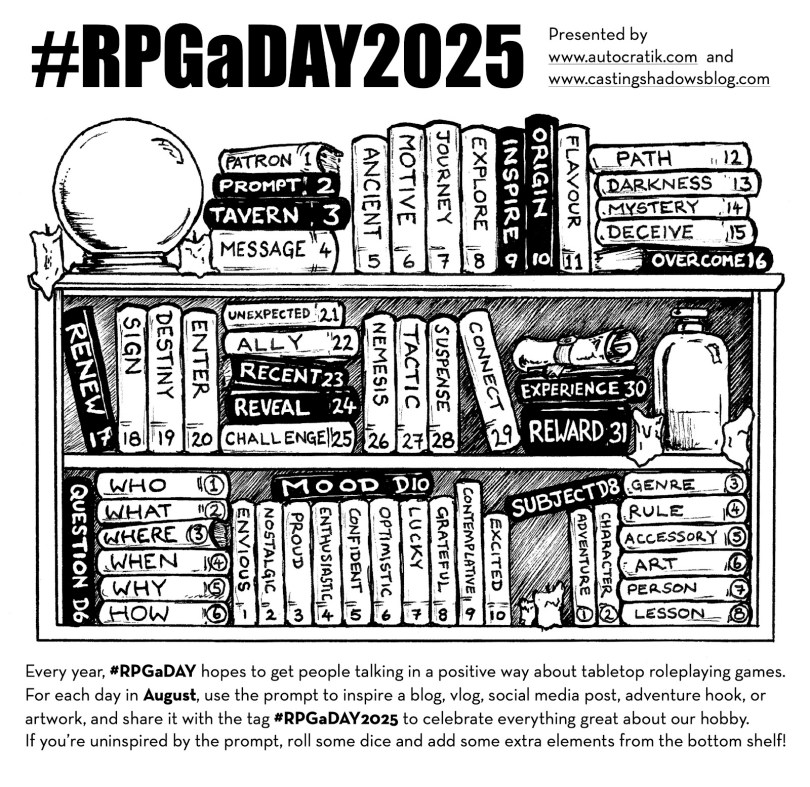
Picture of a bookshelf with books who have each a prompt written on their spine. Daily Prompts 1) Patron 2) Prompt 3) Tavern 4) Message 5) Ancient 6) Motive 7) Journey 8) Explore 9) Inspire 10) Origin 11) Flavour 12) Path 13) Darkness 14) Mystery 15) Deceive 16) Overcome 17) Renew 18) Sign 19) Destiny 20) Enter 21) Unexpected 22) Ally 23) Recent 24) Reveal 25) Challenge 26) Nemesis 27) Tactic 28) Suspense 29) Connect 30) Experience 31) Reward Question Prompts (roll D6) 1) Who 2) What 3) Where 4) When 5) Why 6) How Mood Prompts (roll D10) 1) Envious 2) Nostalgic 3) Proud 4) Enthusiastic 5) Confident 6) Optimistic 7) Lucky 8) Grateful 9) Contemplative 10) Excited Subject Prompts (roll D8) 1) Adventure 2) Character 3) Genre 4) Rule 5) Accessory 6) Art 7) Person 8) Lesson

#RPGaDay2025 Day 13: Darkness

Listen. I struggle with this prompt. What do I have to say about Darkness with regards to RPGs? What do I connect with this term? First thing comes to mind is mental struggles and how TTRPGs can help with that.

I’m not qualified to talk about how playing these games can be therapeutic–I read some articles on how some people might find some sort of emotional help in games, but I’m not the right person to dig into that. It’s just the first thing that came to mind with this prompt on that topic.

Here’s a Darkness I know well, though: Burnout.

See, I’m am a forever-GM, as they say. Not because I feel that I have to, but because I want to. I love running, and, honestly, I feel like I’m not a great player. Can’t turn off that GM-brain, whether it comes to making rulings or to explore characters of other players, or whatever. I try. It’s fine. But behind the screen is where I belong, in the end.

But I had dark times with that, too. For so many reasons, really. I struggled with running and playing 5e after a few years, for example. But at the time, I didn’t know of a good alternative, and even if I would have, I wasn’t sure my group would enjoy it. So I powered through it, session after session. And it wasn’t all bad, I guess. But I didn’t enjoy myself, didn’t look forward to the next Sunday. Even remembering it now, it feels stressful and, yeah, dark.

One day, though, I had enough. I just told them. I was honest about me not having fun. Not because of them, but because of this game I was just so done with. Because of the campaign we wanted to play being so poorly written, and because the game just not really feeling like it was going anywhere. This is heartbreaking, because we successfully finished several campaigns before. We saw characters rise and shine, die, come back, and change over the course of months. But now, it all just really sucked. I think they all felt it too.

So I spoke up. Said my truth.

And you know what? They heard me. We stopped. Right then and there. I told them that I want to try some other systems, and so we did. Savage Worlds was next. Blades in the Dark came right after. One of them ran Lancer for us for a bit, and then I ran it for a while. Same person ran Pathfinder 2 for us, but I didn’t vibe with that all that much. We noodled around for a bit, unsure of what to play, messing around with this and that.

Then came Draw Steel, and that seemed to revitalize the group again. It’s been going strong since then, and I once again look forward to every session. We’ve been building out our own lore, the characters are so full of potential, and I’m enjoying my time preparing for the next Sunday.

Here’s my point: If you feel GM burnout, talk to your players. Be honest. Open, vulnerable even, if that’s what it takes. Whatever level of trust you have with them, lean on that. Ask them to run something. Even taking a break for a single sessions could make all the difference.

I have since learned to let go of the wheel more often. Outside of my regular Sunday game, we play a game once every week with a slightly less consistent cast, trying out new games every few weeks. And I am not running any of them at the moment. In fact, my players–friends–have all offered to run something next. So our to-play schedule is full right now, and I can relax and just learn to be a better player.

I realize how lucky I am here. It’s hard to find people, harder to keep them around. But if you’re like me, if running game is your passion but your heart just isn’t in it right now, please–please–take a break. And if you can, trust your players to have your back. Don’t let the game become a chore, the next sessions hang over you like a dark cloud. Lots of things to worry about these days, this doesn’t need to be one of them.

Picture of a bookshelf with books who have each a prompt written on their spine. Daily Prompts 1) Patron 2) Prompt 3) Tavern 4) Message 5) Ancient 6) Motive 7) Journey 8) Explore 9) Inspire 10) Origin 11) Flavour 12) Path 13) Darkness 14) Mystery 15) Deceive 16) Overcome 17) Renew 18) Sign 19) Destiny 20) Enter 21) Unexpected 22) Ally 23) Recent 24) Reveal 25) Challenge 26) Nemesis 27) Tactic 28) Suspense 29) Connect 30) Experience 31) Reward Question Prompts (roll D6) 1) Who 2) What 3) Where 4) When 5) Why 6) How Mood Prompts (roll D10) 1) Envious 2) Nostalgic 3) Proud 4) Enthusiastic 5) Confident 6) Optimistic 7) Lucky 8) Grateful 9) Contemplative 10) Excited Subject Prompts (roll D8) 1) Adventure 2) Character 3) Genre 4) Rule 5) Accessory 6) Art 7) Person 8) Lesson

#RPGaDay2025 Day 12: Path

Railroading is good, actually.

Not for every group; probably not even for most groups. But it can work. It’s can be a great tool for any GM.

A set path for the campaign/adventure/quest ahead. Maybe you’re short on time, or don’t get to get together all that often, or you just need a quick game to run to break things up. A well intended railroad can enhance a game rather than detract from it.

Here’s the key, though: Tell your players. Tell them, ask them what they think, and make it clear why you think this is a better approach for what you’re doing. Trust me, it works.

I once ran D&D 5e Curse of Strahd for a group in the before-days, before in-person games just stopped. It was a great group, though. New players, veteran players, people that like the mechanics, people that love the fluff of it all. Unfortunately, we could only play every other week for work reasons. And even then, we only had 2-3 hours a session. Scheduling was tight, but the game was fun.

A bit of a way into the campaign, which I ran mostly as written (as far as anyone can run a published 5e campaign as written), I realized that, maybe, I needed to switch things up. Just to keep the pace up, keep things exciting and the fiction tight. A two-hour session only really has time for a set piece encounter, combat or otherwise, and some free play. And only playing every other week made it harder to keep things engaging, as people have lives and forget things.

So I suggested to them to trim the campaign down a bit and run it more like a railroad. I used that word and all. I explained that, instead of letting them explore the map freely as a sandbox point crawl, I would guide them more strongly from set piece to set piece, plotting their path through this campaign more tightly and intentional. Now, that didn’t mean they won’t have influence over the story–it’s their story, not mine, after all. Their choices and decisions would carry forward, just that the main set pieces are laid out by me ahead of time.

One of the important bits is to provide choices for the players, just not an open inventation to do whatever. Whenever more than one logical set piece could come up next, ask them which path they want to take. Kind of like a choose-your-own-adventure book. See, even a railroad has switches that change the path ahead.

Think of it as playing Baldur’s Gate 3. It’s a good game. Great even. You have so many choices, paths to take, people to meet or kill or fuck, and do whatever the hell you want. But every act, you end up in the same place, the same narrative, the same things. Just, your previous choices might carry forward each act. It’s a video game, so you’re on at least some rails. You can’t really change where you end up, just how you get there.

I recall the final fight of Critical Role season 1. The fight against Vecna at the top of his evil tower. The party was smart. They rested up and used powerful magic to topple the entire evil tower. Mercer let it happen, obviously. But then, he describe how the top of the tower, where the Vecna fight was going to happen, was shielded from the magic and floated to ground gently. He had to do that because he created the encounter using physical pieces for the battle map. That fight was always going to happen, right there, at the top of the tower. The players were still rewarded. They bypassed the entire interior of the tower, which was meant to reduce their resources before the final fight. It’s 5e, after all.

Is that railroading? I think so, yes. Mercer probably pulled a lot of these tricks throughout. Shape the fiction, present the goings on in just such a way to ensure the set pieces he planned for can fit it in.

The Alien RPG’s greatest strength are pre-written scenarios. They come with premade characters, each having their own secret agenda. They’re played out over three acts with set triggers for when to switch to the next act. Every act, the secret agenda of each character changes, advances. Players are strongly encourage to play into these agendas, which get worse with each act. These cinematic scenarios are as much of a railroad as a TTRPG can be. But they’re fun. They really let you explore the horror and humanity of the Alien universe within a very tight, very strict framework. You’re playing out an Alien movie! It’s the dream!

Railroading works. it works well, actually. As long the context is clear, the players are aware of the constraints of the game they’re engaging in, and as long as their choices and moments still matter. As long as they’re still the focus of the game, it’ll be fine.

That Strahd game was great, by the way. Lots of cool moments of Strahd causing trouble, an emotional character death, and a grand finale against the vampire lord. It all came together so well, and we did it in just a few months, playing every other week for 2 or 3 hours. Each session mattered. Everyone had fun. Did we explore all of the campaign? Probably not, but the bits we did served the story and the characters, and the conclusion made it all worth it.

Coming Soon…

Hello there.

My name is Stefan, and I like playing TTRPG. And preparing to run them. And designing stuff for the games I run. And designing my own games.

This blog is me wanting/needing to talk about all of that and more. I’ve been playing for more than half my life, starting when I was 15, back in Germany. I came by it sort of by accident, then. I got kicked out of French class (on purpose, the teacher sucked), and went out for a smoke (it’s Europe, everyone smokes there). There, I ran into the cousin of a friend of mine. Met that guy once before. He was waiting for his cousin to finish school and past the time reading a small magazine.

That turned out to be a supplement for small little German game called Das Schwarze Auge (The Dark Eye). It’s a fantasy game like D&D and quite popular in Germany. Been around for forever, lots of supplements, lots of rules, lots of LARPS.

I asked him about it and he said it’s a “role playing game.” I don’t remember his exact words at the time, but when he explained it to me, he said something to the effect of:

“Imagine you are out in the countryside of a medieval realm, walking along the dirt trail. Then you see in the distance a large, dark cloud rising from the horizon. Soon enough, you realize it’s not a normal cloud at all, but a cloud of dust and dirt thrown up an advancing band of marauding orcs. And they’re headed straight for you. What do you do?”

And all I thought was: That sounds lame.

Well, first impressions aside, it somehow stuck with me. Maybe it’s because I always had a creative knack, a need to tell stories and craft systems (I used to make my own campaigns in Starcraft using their simple editor). Maybe I was just bored. But somehow, I ended up becoming friends with him, and together we got our small group of nerds-to-be into playing games. Not Das Schwarze Auge, though. Shadowrun 3rd Edition and Vampire, The Masquerade were our games of choice for a long time.

Well.

25+ years later, here we are. I’ve been running and playing countless games at this point. From long-lasting D&D campaigns, to short one-shot games here and there. I run a small Discord server filled with people I play two weekly games with since 2017. Things are going great. Currently, we’re playing MCDM’s fantastic Draw Steel every Sunday, and sample all sorts of games during the week. There, we play Triangle Agency, and on the short list for future games are Daggerheart, Mythic Bastionland, Neon City Outlaws (not released yet), Hollows (not released yet), and many more. I plan on talking about them here at some point in the future.

I also write my own game(s)–nothing to show just yet, but things are progressing. This blog is meant to be a platform to talk about these designs, my ideas, musings, lessons learned, and so on. Besides that, game reviews (or overviews or first-looks), and whatever else comes to mind with regards to TTRPGs and other media.

Currently, I’m working on Project Star Quest, a game about space adventures in humanity’s dark future. It mixes deep narrative mechanics with streamlined but tactical combat. Of all the projects I haven’t finished, this is my most ambitious yet. More of that later.

Thanks for checking me out. Appreciate any and all engagement.

Stefan