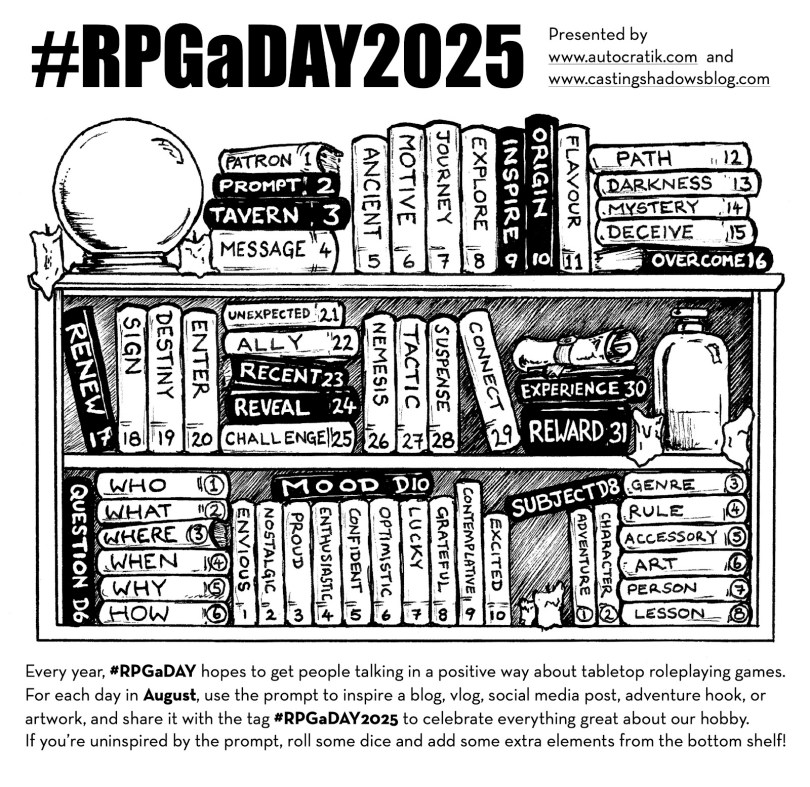
The prompt, Origin, didn’t spark an idea right away, except for maybe talking about Backstories in a TTRPG? So I rolled on the inspirations provided on the bottom. Got why – confident – person.
So, let’s talk about background stories in RPGs. What makes your character a real person that exists in the world of the game? What’s their relations to the themes and motifs; what makes you excited and curious about exploring this character?
Since it’s brand new, and also happens to be my group’s choice of game for the next while, let’s take a look at how you create your backstory for a Draw Steel character.
A Draw Steel character is made up of four key pillars: Ancestry, Culture, Career, Class.
Ancestry is straight forward, of course. Elf, Orc, Human, you name it. They give you some choices to customize ancestral traits, which is nice. Nothing all too new here in terms of what an Ancestry is. Though the options are cool, and Matt Colville has some interesting and unique takes on some of the more common tropes like Elves. While your Ancestry won’t and shouldn’t tell you who your character is, it does give you an initial, general impression of who your character is. Thanks to their fey relationship to the fabled Star Elves, Wode Elves will generally look at the world differently than a Devil, which got stuck in the world after a bad deal went worse. Humans have an interesting relationship to magic, naturally resistant and yet sensitive to it, while Dragon Knights are diminished survivors of an invasion by the big bad evil guy of the setting, Ajax, The Iron Saint.
Class is about as clear-cut as a game of this genre could be. Though, Draw Steel has some more flavorful and unique takes on the tried and true classics. You’re not just a Fighter, you’re a Tactician able to lead your party through danger. You’re not a just a Rogue, you’re a Shadow, using black ash magic and alchemy to outsmart your opponents. You’re not a Paladin, you’re a Censor on a holy crusade to judge the evils of the world. With that comes a lot of identity and flavor, and even the ability names are often evocative and wild.
“Halt, Miscreant!” “My Life For Yours” “Hesitation Is Weakness” “The Flesh, A Crucible”
Finally, your class starts with a lot of cool and interesting things even at level 1. In fact, level 1 has the most amount of choices to make, which takes a bit of time, but gives you a fully capable hero that has already seen a fight or two, saved a person or village before even sessions 1 takes place. Levels beyond 1 usually give a few more minor perks and a choice of an ability. Nothing as complex as level 1.
Culture is your first step into creating a truly realized character. Your background is split into three categories:
- Environment, such as nomadic, rural, secluded, urbane, wilderness. It’s where you community or communities are generally found, their place in the world.
- Organization; Bureaucratic, Communal. This describe the functional form of leadership of your culture.
- Upbringing, which tells you how your character specifically was brought up in that culture. Academic, Creative, Labor, Lawless, Martial, Noble.
All of these options give you insights into where you character came from before becoming a hero out to save the world. They also give you skill choices to round out your character mechanically.
Career describes the things you did before becoming a hero. Your normal life before something forced you to give it all up in pursued of fighting monsters and saving people. Besides more skill options and some other perks, careers make you choose/roll on/invent an inciting incident. The thing that happened to you that changed everything. Something that was taken from you, that set you on a new path. Whether it’s fame and fortune you seek, revenge, or hope, your old life is behind you, and the life of a hero awaits.
All these four parts taken together gives you such a well-rounded character right out of the gate. Yeah, it might take a bit longer, you have to make a fair amount of choices, but it’s worth it. You know who your character is, where the came from, and why they’re here now.
I don’t think it’s needed, or even useful, to write long backstories. No one ever really reads them, and it’s not fair to ask your GM to figure out a way to include all of that information somehow into their game. Unless they asked for this, of course. Draw Steel’s character creation gives you just enough insight into your background to imply a backstory. Not much more is needed, not really. Your culture, with its environment, organization, upbringing, will give the GM enough to build on should the adventure ever take you home. Your career and inciting incident gives you enough inspiration to roleplay your character and explore why they would make the choices they do.
It’s honestly great. Not so much that it becomes overwhelming; just enough to make your character feel real.
 Behind The Wall