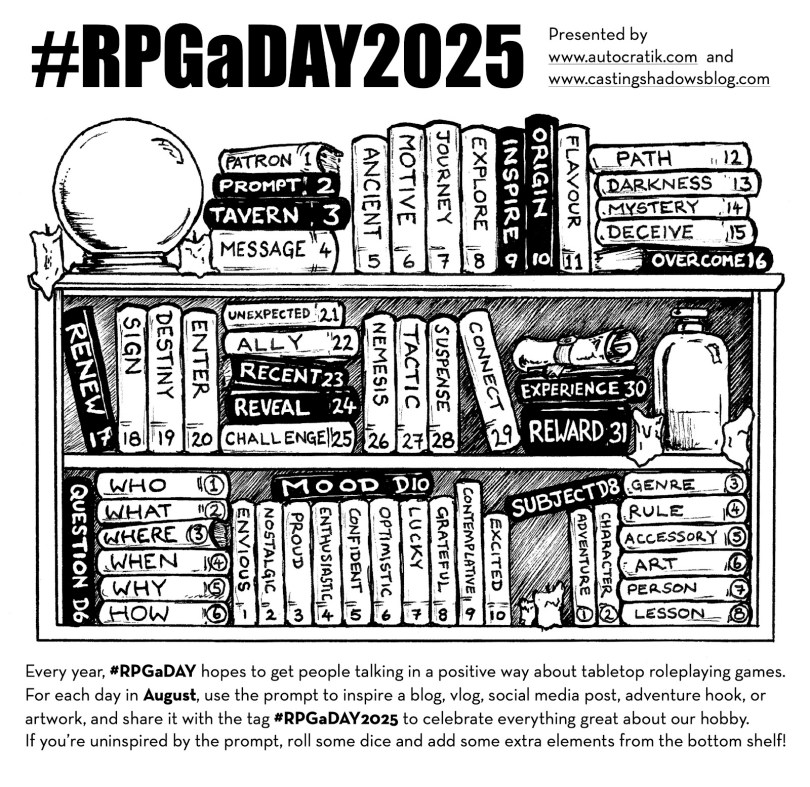
I didn’t make yesterday’s prompt because I just didn’t really feel it. Nothing came to mind for “Enter” — at least not anything interesting enough to talk about.
Today’s prompt is “Unexpected,” so let’s just combine these two into one thing: Mythic GME.
I’ve talked about using Mythic many times at this point. It’s an engine that can replace the GM, enabling solo or cooptative play. To me, however, it’s also a great tool to prep for and run games. Let’s talk about entering something unexpected into your games.
Once upon a time, after we had enough of 5e, my players and I played a short game of Savage Worlds–a gritty, gonzo lore-agnostic game. I really like it, so I convinced them to try it. See, the game that made me want to quit D&D for good was very heavy on prep. It was a full campaign after all, and the characters were all really cool. So I did my best to keep things just as cool and intriguing. But, due to life being life, the game fell apart. The campaign itself was written so poorly, I had to change pretty much everything; two players left due to scheduling issues, right in the midst of us exploring their character beats. It was a bit much. So, when we started Savage Worlds, I decided to actively use Mythic GME to run it. Not just in the background, no, but together with the players. We would use Mythic’s system to establish scenes, check for random interruptions, and roll on prompts together and talk about them as we go. I still had the final say on GM-related parts, of course.
That was a lot of fun, and changed the game in so many interesting ways.
They game was about them playing a criminal gang in the town of Luskan. I set it up that way to warm them up the idea of playing Blades in the Dark, and it worked well. As part of that, they entered into a relationship with an up and coming crime boss, Lady Von Smoot. We all pictured their relationship as a strained one, it being only a matter of time before one side would turn on the other.
One day, we were down a player. Since we weren’t really in the middle of anything, I just used Mythic to roll up a random event to get us started. I don’t remember all the details, but the event itself was “NPC negative” and another random roll told us it was “Lady Von Smoot” who was affected. How interesting? We rolled more prompts, asking questions and letting the inspiration guide us, and in just a few minutes, we came up with this really cool hook. Apparently, Lady Von Smoot was making a deal with a Pirate Boss who backstabbed her. Literally. Now, the Lady was stumbling through the dark streets of Luskan, a dagger in her side, blood mixing with the rain. Nowhere to turn, she sought out the party. She didn’t trust them much, but they were the only people she didn’t suspect to be part of that coup against her rising crime enterprise.
See. None of us would have thought of that–I sure wasn’t But we entered a random event, let us be inspired by the random prompts of Mythic GME, and talked it through together. And it led us down such a cool story.
I think preparing big campaigns and stories, NPC, worldbuilding, can be a great exercise. But most of that, the players won’t ever engage with, right? I have started to use Mythic in my prep work pretty much all the time. It doesn’t tell you what to do–what would you do with a prompt rolled on two tables that reads “Reward/Safety” or “Waste/Group” in a vacuum? It’s nonsense. But what if you ask a question, like, “What happened to Lady Von Smoot?” and you get “Harm Energy” as a prompt? With everything you know about her, maybe you start thinking about someone casting a spell to hurt her. Maybe she tried to harm someone in a fit of rage. It’s not about what the words actually mean, it’s the images and ideas they conjure in the moment within the context of all that came before.
It’s procedural storytelling. And letting in the ideas conjured can lead to strange and interesting places you’d never consider otherwise.
 Behind The Wall